How I look for a dev job
My experience looking for a developer job, where to find opportunities, and how to improve at each stage of the process.
In December 2025, I started looking for a new job. I sent 15 emails. Two weeks later, I had 3 offers.
I believe the job search process has a logic you can understand, improve, and repeat. And because the narrative that "developers are no longer needed" doesn't hold up against the data.
The data nobody is looking at
If you spend time on social media or tech forums, the general feeling is that the developer market is dead. AI will replace us all. There are no jobs. It's over.
The data tells a different story.
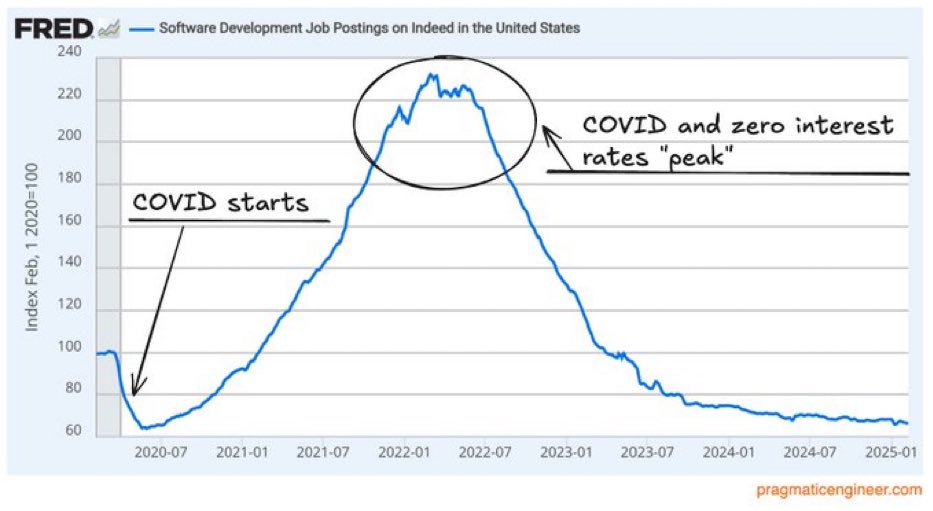
This FRED chart (via Pragmatic Engineer) shows what actually happened: between 2020 and 2022, with zero interest rates and the remote work explosion, software job postings went to double their normal levels. That wasn't the baseline. It was a bubble. The 2023-2024 decline was a correction, not a collapse.
Now look at what's been happening since late 2025:
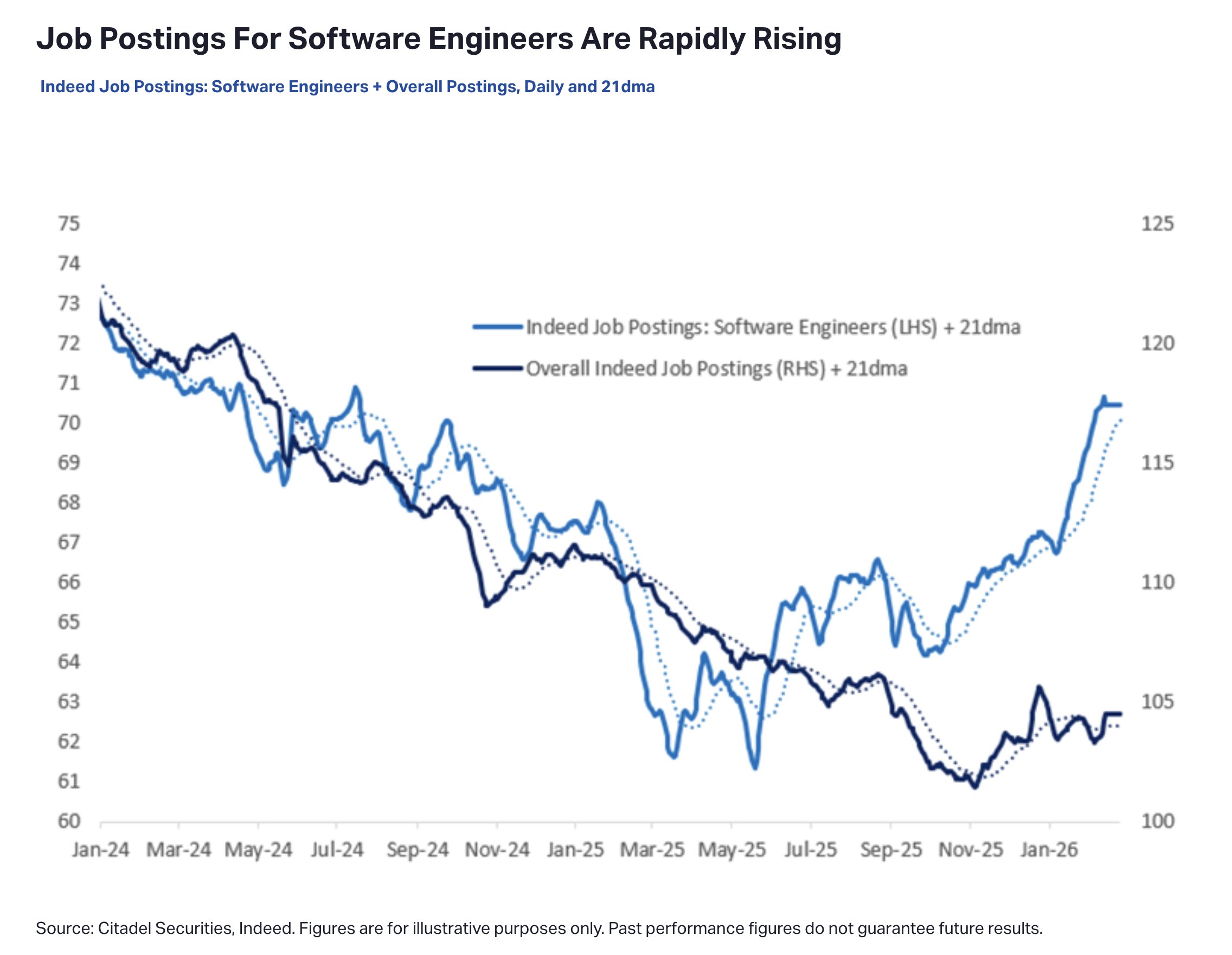
Software engineer postings are rising while overall job postings stay flat. Developer demand is diverging from the general market. The Bureau of Labor Statistics projects 17% growth through 2033, with over 327,000 new positions in the US alone.
Developers aren't surplus. What changed is what companies are looking for and how they hire.
Where to find opportunities
Everyone has their own approach. This is mine, and it's evolved over the years.
LinkedIn is still an important source, but not just the Jobs section. Many recruiters don't post openings there. What worked for me earlier in my career was adding recruiters to my network and searching keywords like "react developer remote" or "typescript remote" in the feed. Recruiters posting about open roles show up there and never make it to the jobs section.
Company career pages. If you have companies you're interested in, go directly to their careers page. It's more work, but it's a natural filter: you're applying to places you actually want to work, not throwing CVs into the void. If you need inspiration to find companies, topstartups.io has a good filterable list by location, funding round, and more.
Hacker News "Who is hiring?". This was my main source for my last two jobs. Every month, a thread goes up on Hacker News where startups and companies of all kinds post openings. The March 2026 thread has hundreds of opportunities. For easier filtering, I use hnhiring.com which lets you search by technology, location, and job type.
When filtering opportunities, pay attention to timezones. If a listing says "US remote", don't apply if you're not in the United States. But if it's a US company asking for shared timezone or mentioning "Americas timezone", they'll likely accept candidates from Latin America. Those are good opportunities to look into.
Remote work platforms. We Work Remotely is one of the most established remote job boards, only listing companies that work 100% remotely. If you're looking for Spanish-language listings or region-focused platforms, WeRemoto, RemotoList, and Workremoto post remote jobs for Spanish speakers.
English as a multiplier
If you don't live in the US or Europe, knowing English isn't a nice-to-have, it's what opens the market for you. The remote opportunities with better products, better salaries, and better teams are in English. It's not optional if you want access to them.
To put it in numbers: a developer in Latin America working for the local market might earn $15,000-$30,000 USD per year. Working remotely in English for US or European companies, that range jumps to $53,000-$63,000 USD. That's 2-3x the local salary for the same work, from home.
If you're in Latin America, you also have an advantage that doesn't get talked about enough: timezone. The time difference with the US East Coast is 0 to 3 hours. That makes you much more attractive than a developer in Asia for any company that needs real-time collaboration. Companies know this, and more and more are actively looking for talent in the region because of it.
Working remotely from Latin America
I was in Argentina when I started working remotely for companies abroad. It has its risks, but it's worth it.
Something worth understanding: developer salaries in the United States are at a level that's hard to imagine for someone who doesn't live there. They won't pay you that. But that doesn't mean American developers are at another level of skill. I met very talented people in Argentina, as much or more than anywhere else. The difference is cost of living and the market, not talent.
US companies tend to have a very work-oriented culture and often fewer holidays and benefits than countries like Argentina or Spain. Even so, negotiating even a percentage of what a US dev would earn results in an excellent salary for someone in Latin America. It's a deal where both sides win.
The reality of being a contractor
You'll most likely work as a contractor. That means you need to pay attention to the conditions before accepting: whether they cover sick days, holidays, your work equipment. Most serious companies do, but ask. You also need to understand the tax implications, because being an employee and invoicing as an independent contractor are very different things. Get informed about your tax situation before making the leap.
It depends on your priorities, but there are things that might not seem ideal at first. When I worked for a US company as a direct contractor (no agencies in between), the holidays were US holidays, not local ones. Sometimes a meeting would land at a time that wasn't great for my timezone. Generally people respect each other's schedules, but it can happen.
It can look overwhelming, but don't be afraid of it. In several cases I know, it worked out great.
Working for an agency in Argentina (or your country) that has US clients is also a good way to start. You learn communication skills, get used to the work culture, and gain experience with international teams. But if at some point you want a real jump in salary, working directly for the company is where the real difference is. There are also stories of people who started at an agency and then the client wanted to hire them directly. It's not always easy because of non-competition agreements, but it happens.
These are trade-offs. For me, it was worth it. If you're in a position to make that leap, I recommend it.
Looking for a job is a job
This sounds obvious, but many people underestimate it. Job searching takes time, dedication, and energy. You'll feel frustrated. You'll think you wasted time on processes that went nowhere. That's part of it.
If you're like me, you'll also enjoy it. Every interview is a chance to learn something new. Every process teaches you something about yourself, the industry, or how that company works.
But the key is understanding where you're getting stuck.
One important tip: don't wait until you meet 100% of a job's requirements to apply. If you meet half, send your resume. You already have the "no". Make sure you have a good resume, good timing, and if they call you, go to the interview prepared: research the company, understand what they do, and review the tech stack they use.
That said, if they ask for intermediate or advanced English and you can't hold a conversation, work on that first. They will ask you to speak in English, and there's no way around it.
Know where you're getting stuck
My numbers: 15 emails, 7 rejections, 2 asked me to record a video (I didn't), 4 wanted to proceed, 2 responded late when I was already in final stages. Result: 3 offers.
It went better than I expected, but there's context. I was targeting a world I know well: startups that post on Hacker News, where communication is more direct. Some of those rejections were expected because I applied for backend roles in Go or Rust, languages I learned on my own but where my strength is TypeScript. I wanted to try anyway.
If you're using LinkedIn or other platforms, don't be surprised if the ratio is very different. Sending 100 applications and hearing back from 10 is normal there. That's why it's important to use all available channels and not depend on a single one.
What matters isn't how many applications you send. It's identifying which stage is breaking your process and working on that:
No response after sending your resume. Could be the resume, could be timing. For junior positions, they already ask for experience, and a GitHub repository with projects helps, but what recruiters really want to validate is that you've worked with other people. Hackathons, projects with friends, open source contributions, any evidence of real collaboration. Timing also matters: if the listing is a week old, hundreds of people have probably already seen it. Spending time every day searching and applying to new openings is key. And today, many recruiters use AI for the first filter, so make sure your resume is readable by those tools.
You're not getting past HR. Prepare better. Many questions repeat across processes. The first time, you might not know what to answer or you get nervous. That's normal. But if you're consistently failing at HR across multiple processes, something needs adjusting.
You're stuck at the technical interview. There's a range: some are conversational Q&A, others ask you to share your screen and work through something together. You can usually deduce the format by how much time they scheduled. In general, they should let you use the tools you use day to day, including AI. In fact, for many interviewers today it's important to evaluate exactly that: how you apply the right context, how you write the prompt, how you review what's generated. Read up on the tech stack they're asking for, review the concepts before the interview. This applies at every seniority level.
The code challenge (optional). Some processes include an exercise to solve on your own time. They give you a problem and a deadline, and you deliver the solution. One tip: if there are things you know should be there but aren't specified in the requirements, mention them as "out of scope" in the README. E2E tests, better unit test coverage, validations, login logic, whatever is relevant. This shows the interviewer that you're aware it's needed but you chose not to include it to keep the solution focused. That says more about you than delivering something incomplete with no explanation. Keep in mind that the code challenge won't just be reviewed: if you move forward in the process, they'll likely do an interview based on questions about your solution. Make sure you understand every decision you made and can defend it.
The system design interview. This depends on seniority and the role. In my case, I applied for fullstack positions and had interviews where they asked me to design a WhatsApp-like application in Excalidraw, with components that scale for 100 million active users. Others were much lighter: "What would you do if the application gets 10x traffic during the same 4 hours every day?" The first one was challenging, I lacked knowledge of some AWS services to paint a better high-level picture. The second was more straightforward: if you've used Kubernetes, you already know how to approach that kind of scaling. After that one they asked about 10 more questions, but at a similar difficulty level, nothing out of the ordinary. Not all design interviews are the same, and not all require the same level of depth.
You get an offer. Some companies will rush you to decide. Something I learned is that I had the power to negotiate a few extra days to finish other processes, compare offers properly, and make an informed decision.
Different stages, different strategies
My experience is as a senior engineer, but before that I was mid-level, and before that junior, years before the "easy market" of 2020-2021. What works at each level is different.
If you're a junior, the market isn't what it used to be. Unfortunately, the 2021-2022 era when bootcamps flourished and quick job placements were common is gone. As the chart above shows, that market was an exception, not the rule. Entry-level postings have dropped compared to those years, and companies generally prefer people who can contribute faster.
But that doesn't mean there's no path. Before 2020, people could get into IT just fine, I started in 2010, and you still can now. If you were sold the "bootcamp" vision from a few years ago as a guaranteed path, unfortunately that's no longer the reality. But the industry still needs new people.
If you're junior, there are many tech influencers who help people getting started and can prepare you for the challenges and frustrations of the process. Seek them out, the information is there.
If you're struggling to land that first opportunity, some things that work: target mid-size companies and B2B sectors (logistics, manufacturing, insurance) where there's demand but less competition. Build 3 to 5 real projects in your portfolio, not tutorial exercises. And most importantly: show that you've worked with other people. A hackathon project with a solid README, or a contribution to an open source project, is worth more than 10 repositories of to-do apps. Recruiters want to validate that you can collaborate on a team, not just that you can write code alone.
As a senior, the challenge is different: finding the right opportunity, not just any opportunity.
Nearshoring is a tailwind
If you're in Latin America, there's a structural shift you can benefit from: nearshoring. US companies are actively seeking talent in the region. The LATAM IT outsourcing market grew to $70.8 billion in 2024 and is projected to reach $126 billion by 2030.
Why? Because the timezone is almost the same, the cost difference is significant, and the talent quality is high. Companies already know this and more and more are building teams in the region.
This is a tailwind for any developer in LATAM who knows English and has the technical skills. The demand isn't just for seniors: companies are building full teams, from juniors to tech leads.
What doesn't change is the principle: understand where your process breaks, work on that, and keep going. Every process you learn from brings you closer to the next one that works out.